
Significant Figures Calculator (Sig Figs Calculator & Counter)
This free online sig fig calculator counts significant figures (significant digits), rounds to any precision and solves calculations with the correct sig figs, step by step.
Type one number to count its significant figures, or a calculation to get the answer with the right sig figs.
Round to significant figures
Pick how many significant figures to round to.
Rules this calculator follows
- Non-zero digits are always significant. Zeros between them are significant.
- Leading zeros (0.0047) are never significant.
- Trailing zeros count only with a decimal point: 1200 has 2, 1200. has 4.
- + and −: the answer keeps the fewest decimal places.
- × and ÷: the answer keeps the fewest significant figures.
- Powers: the result keeps the base's sig figs. log/ln: sig figs of the input become decimal places. Antilog (10^x): the reverse.
- Full precision is carried through every step and rounded once at the end (round half up), so no rounding error builds up.
Whether you call it a significant figures calculator, a significant figure calculator or a significant digits calculator, the job is the same: give an answer that is no more precise than the measurements behind it. This sigfig calculator counts sig figs, works as a rounding significant figures calculator, and handles addition, subtraction, multiplication, division, powers, logarithms and antilogs. Every answer comes with steps plus scientific notation and E notation, so it is a sig fig calculator with steps you can use for homework, lab reports and exam revision.
How to Use the Sig Fig Calculator
This sig fig calculator works from a single input box. Type a number to count its significant figures, or type a calculation to get the answer with the correct number of sig figs. Results update as you type, so there is nothing to submit.
Count Significant Figures (Sig Fig Counter)
Enter any number, such as 0.004560, 1200 or 6.022 × 10^23. The sig fig counter shows how many significant figures it has, highlights the significant digits and underlines the least significant digit. It also lists the decimal places, the scientific notation and the E notation. For 0.004560 you get 4 significant figures: the leading zeros are only placeholders, while the final zero was measured. Use it as a significant figures counter whenever you need to check how many sig figs a measurement has.
Round to N Significant Figures
This round to significant figures calculator works on any result. Pick 1 to 6 sig figs in the Round to significant figures box, or type your own number. Rounding 0.0045678 to 3 significant figures gives 0.00457, and when you round to 2 significant figures, 432.75 becomes 430, which the calculator also shows as 4.3 × 10² so the precision stays clear.
Calculate with Sig Figs (+ − × ÷, ^, log, ln, antilog)
Type an expression using +, −, ×, ÷, ^, parentheses, log, ln, sqrt or antilog. The significant figures calculator applies the correct rule at every step, keeps extra digits until the end, and gives a step-by-step explanation of how the answer was rounded, whether you are adding, multiplying or dividing. On a phone, use the keypad buttons under the input. Scientific notation works too: 3.2 × 10^-4 and 3.2e-4 are read the same way.
What Are Significant Figures (Significant Digits)?
Significant figures, also called significant digits, are the digits in a number that carry real information about its precision, which is why they are the standard way to express measurement uncertainty. They include every digit you are certain of plus the first estimated digit. If a ruler marked in millimetres gives you 12.5 cm, all three digits are significant: you are sure of the 12, and the 5 is your best estimate between two marks.
Sig figs matter because a calculated answer cannot be more precise than the measurements behind it. A calculator display showing 26.108571 for 15.23 × 3.6 ÷ 2.1 claims far more precision than measurements of 3.6 and 2.1 can support. Reporting 26 is honest; reporting eight digits is not. That is the job of a sig figs calculator: it does the arithmetic, then trims the answer to the precision your data really has.
How to Count Significant Figures: The Rules
Five rules cover almost every number you will meet in class or in the lab. For more worked examples, see our full guide to the significant figures rules.
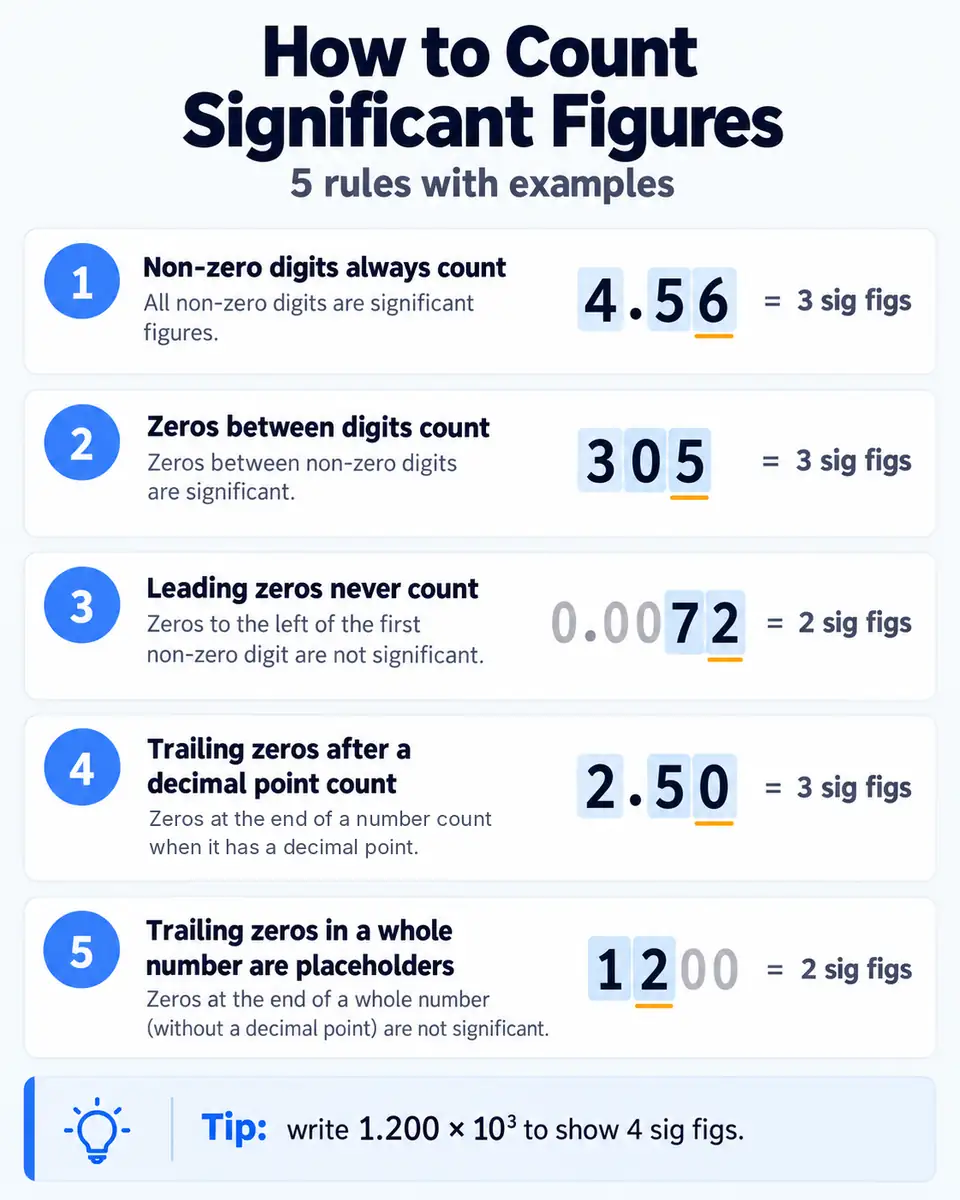
Non-Zero Digits and Captive Zeros
Every non-zero digit is significant. Zeros between non-zero digits, called captive or sandwiched zeros, are significant too, so 305.02 has 5 significant figures.
Are Leading Zeros Significant?
No. Zeros in front of the first non-zero digit only locate the decimal point. 0.0047 has 2 significant figures: the 4 and the 7.
Are Trailing Zeros Significant? (100 vs 100. vs 100.0)
It depends on the decimal point. Trailing zeros after a decimal point were measured, so they count: 5.0300 has 5 significant figures, and so does 100.00. Trailing zeros in a whole number with no decimal point are ambiguous. 1200 could have 2, 3 or 4 significant figures, and the usual convention counts it as 2. To show that the zeros are real, write 1200. with a decimal point (4 sig figs) or use scientific notation, 1.200 × 10³. This calculator counts 1200 as 2 significant figures and flags the ambiguity so you can decide.
Exact Numbers Have Infinite Significant Figures
Counted values and defined conversion factors, such as 3 trials, 12 eggs or 100 cm in 1 m, are exact. They never limit the precision of an answer. Turn on Whole numbers are exact when the whole numbers in your expression are counts: 2 × 3.14159 × 1.5 then gives 9.4 (2 sig figs, set by 1.5) instead of 9.
| Number | Significant figures | Why |
|---|---|---|
| 0.004560 | 4 | Leading zeros do not count; the final zero does |
| 305.02 | 5 | The captive zero counts |
| 1200 | 2 | Trailing zeros with no decimal point are ambiguous |
| 1200. | 4 | The decimal point makes the zeros significant |
| 1.200 × 10³ | 4 | Every digit in the coefficient counts |
| 100.00 | 5 | Zeros after the decimal point count |
| 6.022 × 10²³ | 4 | The exponent never counts |
Round to Significant Figures (Sig Fig Rounder)
To round a number to a set number of significant figures, start counting at the first non-zero digit, stop at the last digit you want to keep, and look at the digit after it. The rounding significant figures calculator above does this for you; here is the method behind it.
How to Round to 3 Significant Figures (and 2 or 4)
- Find the first non-zero digit. In 0.0045678 it is the 4.
- Count three digits from there: 4, 5 and 6.
- Look at the next digit, 7. Because it is 5 or more, round the 6 up to 7.
- The answer is 0.00457.
The same steps give 3.14 for 3.14159 (3 sig figs), 99 for 98.76 (2 sig figs) and 430 for 432.75 (2 sig figs). When rounding leaves zeros that look ambiguous, the calculator also shows scientific notation, so 4.3 × 10² makes it clear that 430 has 2 significant figures.
Round Half Up vs Round Half to Even
When the dropped digit is exactly 5, conventions differ. This sig fig rounder uses round half up, the method taught in most chemistry and physics courses, so 2.5 rounded to 1 significant figure becomes 3. Some labs and statistics programs use round half to even (banker’s rounding), which would give 2. If your instructor uses half to even, adjust those rare exact-5 cases by hand.
Significant Figures Rules for Calculations
Each type of operation has its own rule. The calculator applies them automatically and explains each step in the results.
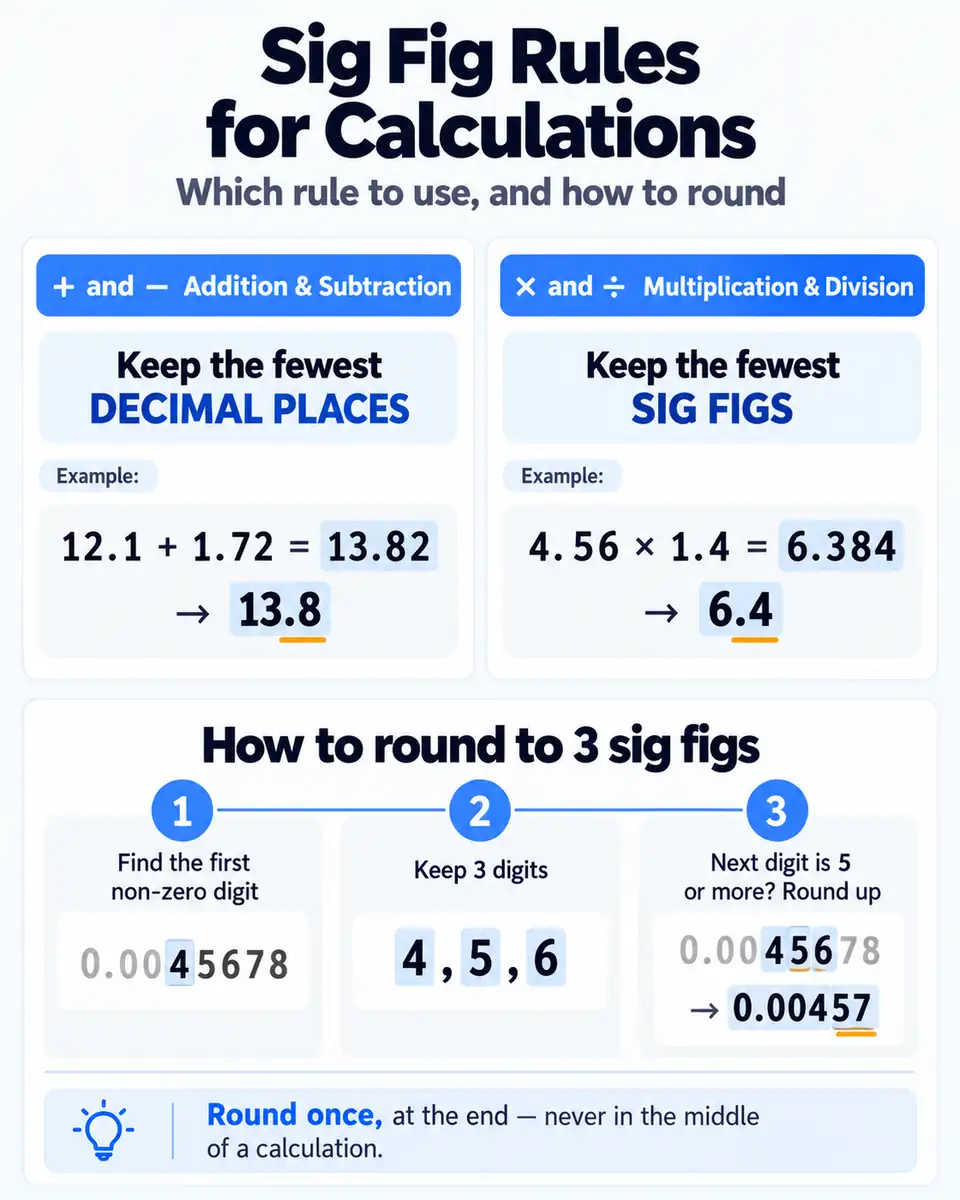
| Operation | Rule | Example |
|---|---|---|
| Addition and subtraction | Keep the fewest decimal places | 12.1 + 1.72 = 13.82 → 13.8 |
| Multiplication and division | Keep the fewest significant figures | 15.23 × 3.6 ÷ 2.1 = 26.1086 → 26 |
| Powers | Keep the sig figs of the base | 2.5² = 6.25 → 6.3 |
| Logarithms (log, ln) | Sig figs of the input become decimal places | log(4.50) = 0.65321 → 0.653 |
| Antilogarithms (10^x, e^x) | Decimal places of the exponent become sig figs | 10^-2.55 = 0.0028184 → 0.0028 |
Addition and Subtraction (Decimal Places Rule)
For sums and differences, precision is set by the number with the fewest decimal places, not the fewest significant figures. In 12.1 + 1.72, the 12.1 is only known to the tenths place, so 13.82 rounds to 13.8. Subtraction can also wipe out significant digits: 1.2 − 1.19 = 0.01, which is 0.0 at tenths precision.
Multiplication and Division (Fewest Sig Figs Rule)
When multiplying significant figures or dividing them, the answer keeps as many significant figures as the input with the fewest. A density of 12.35 g ÷ 4.2 mL = 2.9405 g/mL is reported as 2.9 g/mL, because 4.2 has only 2 significant figures.
Powers and Exponents
When you raise a measured number to a power, the result keeps the significant figures of the base, and the exponent is treated as exact. 2.5² = 6.25 rounds to 6.3.
Logarithms (log, ln) and Antilogarithms
Logarithms follow a special rule: the number of significant figures in the input equals the number of decimal places in the result. log(4.50) has 3 sig figs going in, so the answer is 0.653. This is how pH works: a hydrogen-ion concentration of 3.2 × 10⁻⁴ M (2 sig figs) gives a pH of 3.49 (2 decimal places). Only the mantissa, the digits after the decimal point, counts as significant in a logarithm; the 3 just sets the power of ten. As a logarithm significant figures calculator, the tool applies this rule for you. Going the other way, an antilog keeps as many significant figures as the exponent has decimal places, so 10^-2.55 = 2.8 × 10⁻³.
Mixed Operations: When to Round
In a calculation with several steps, apply the rule for each step but do not round until the end, because rounding in the middle builds up error. For 12.13 + 1.72 × 3.4, the product 5.848 is only good to 2 significant figures (the tenths place), so the sum 17.978 is reported to the tenths place: 18.0. The calculator keeps full precision internally and shows which number limited each step.
Sig Fig Calculator: Scientific Notation and E Notation Output
Every result appears in three forms: standard decimal, scientific notation and E notation. A value such as 488,000 with 3 significant figures is 4.88 × 10⁵ in scientific notation and 4.88e5 in E notation, the format used by spreadsheets, programming languages and many graphing calculators. Scientific notation is also the cleanest way to remove trailing-zero ambiguity, since every digit in the coefficient is significant. You can also use it as a scientific notation significant figures calculator: type 6.022 × 10^23 or 6.022e23 and both work. For the full method, read scientific notation and significant figures.
Significant Figures in Chemistry and Physics
Sig figs show up in almost every lab report. Masses from a balance, volumes from a burette and temperatures from a probe each carry their own precision, and the final answer has to respect the least precise measurement. Students most often reach for a significant figures calculator in chemistry for molar mass and stoichiometry, density and concentration, gas law problems and pH. In physics, sig figs matter in kinematics and any result built from measured lengths, times and masses. Treat defined values, such as unit conversions, as exact so they never cut your precision.
Tip: Use the Copy button to grab the rounded answer, and keep the Unrounded result if you will use the number in a later calculation.
Frequently Asked Questions
How many sig figs are in 100?
100 written without a decimal point has 1 significant figure, because trailing zeros in a whole number are treated as placeholders. 100. has 3, 100.0 has 4 and 100.00 has 5. Our guide to sig figs in 100, 100. and 100.00 walks through each case.
How many significant figures are in 1000?
1000 has 1 significant figure by the usual convention. Write 1000. or 1.000 × 10³ if all four digits were measured.
How do you count significant figures?
Start at the first non-zero digit and count every digit after it. Include captive zeros and trailing zeros after a decimal point, and skip leading zeros. Trailing zeros in a whole number with no decimal point do not count.
Are trailing zeros significant?
Yes when the number has a decimal point: 2.50 has 3 sig figs. Without a decimal point they are ambiguous and usually not counted, so 250 has 2.
How do you round to 3 significant figures?
Keep three digits starting from the first non-zero digit, then look at the next digit: 5 or more rounds up, 4 or less leaves the last kept digit as it is. 0.0045678 becomes 0.00457.
How many sig figs do you keep when adding or subtracting?
Keep the fewest decimal places among the numbers, not the fewest sig figs: 12.1 + 1.72 = 13.8.
What is the sig fig rule for multiplication and division?
The answer keeps the smallest number of significant figures among the inputs: 15.23 × 3.6 ÷ 2.1 = 26.
Does scientific notation change the number of sig figs?
No. Scientific notation only moves the decimal point, so 0.00470 and 4.70 × 10⁻³ both have 3 significant figures. It does make trailing zeros unambiguous.
Do exact numbers have significant figures?
Exact numbers, such as counted items and defined conversion factors, have an unlimited number of significant figures. They never limit the precision of an answer, so only the measured values decide how many sig figs you keep.
How do sig figs work with logarithms and antilogs?
For a logarithm, the sig figs of the input become the decimal places of the result. For an antilog, the decimal places of the exponent become the sig figs of the result.
What is the difference between significant figures and decimal places?
Decimal places count only the digits after the decimal point. Significant figures count every meaningful digit wherever the decimal point is, so 0.0470 has 4 decimal places but 3 significant figures.